
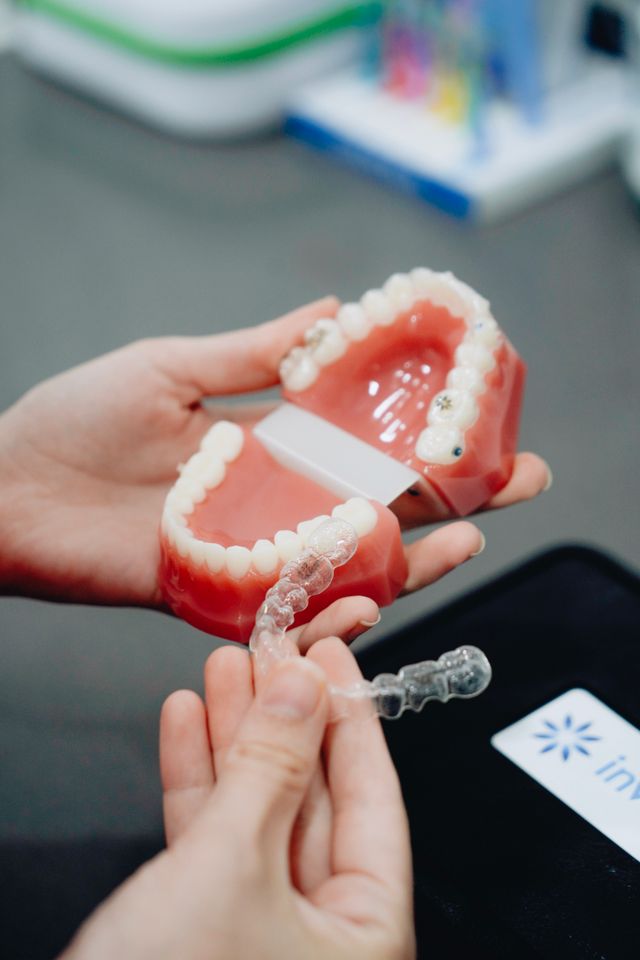
Lingual braces (fitted behind the teeth) and Invisalign are the two most discreet orthodontic options available. Here's how they genuinely compare.
Lingual braces are fixed brackets attached to the back (tongue-facing side) of your teeth, making them invisible from the front. Invisalign achieves invisibility differently, using clear removable aligners. Both aim for the same discretion, but the experience differs significantly.
Side-by-Side Comparison
| Factor | Lingual Braces | Invisalign |
|---|---|---|
| Visibility | Completely hidden from the front | Nearly invisible from any angle |
| Removable | No — fixed for entire treatment | Yes — removable for eating and cleaning |
| Speech adjustment | Often more pronounced, longer adjustment | Mild, 3–5 days |
| Comfort | Can irritate the tongue initially | Smooth plastic, minimal irritation |
| Cleaning | More difficult — behind-teeth brackets are hard to clean | Simple — remove and brush normally |
| Typical cost | Usually higher than both metal braces and Invisalign | From ₹1,20,000 |
Which Is Right for You?
If complete invisibility from every angle (including up close) is your top priority and you're comfortable with a longer speech adjustment and more careful cleaning routine, lingual braces are an option. For most patients prioritising comfort, ease of cleaning, and overall practicality, Invisalign remains the more commonly chosen option.