
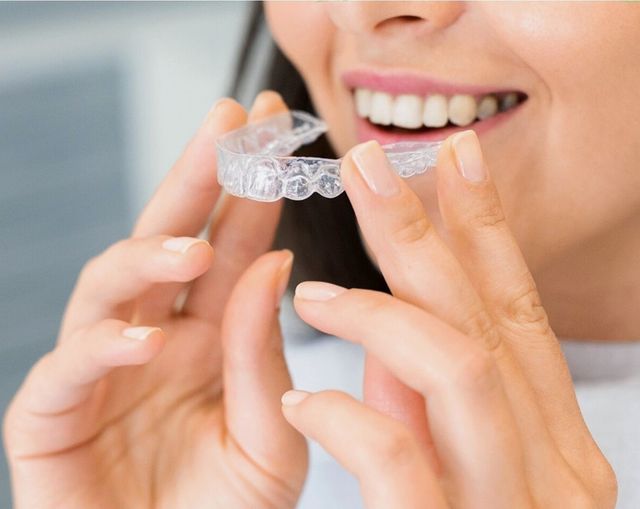
Ceramic braces are often marketed as a 'discreet' alternative to metal braces — but how do they really compare to Invisalign? Here's an honest side-by-side.
Ceramic braces use tooth-coloured brackets instead of metal, making them less visible than traditional braces — but they're still fixed to your teeth, unlike Invisalign's removable aligners. Here's how the two genuinely compare.
Side-by-Side Comparison
| Factor | Ceramic Braces | Invisalign |
|---|---|---|
| Visibility | Less visible than metal, still noticeable up close | Nearly invisible |
| Removable | No — fixed for entire treatment | Yes — removable for eating and cleaning |
| Diet restrictions | Yes — avoid sticky/hard foods | None — remove to eat anything |
| Staining risk | Ceramic brackets can discolour from certain foods/drinks | Minimal, if cleaned regularly |
| Check-up frequency | Every 4–6 weeks | Every 6–8 weeks |
| Typical cost | Often similar to or slightly less than Invisalign | From ₹1,20,000 |
When Ceramic Braces Might Still Be Recommended
Very severe cases requiring precise, continuous control of complex tooth movement — where patient compliance with aligner wear-time is uncertain — may sometimes be better suited to fixed braces (ceramic or metal). This is assessed individually, not assumed by default.
Frequently Asked Questions
Are ceramic braces cheaper than Invisalign?+
Pricing varies by case complexity for both options, but ceramic braces are often priced similarly to or slightly below Invisalign for comparable cases in Hyderabad.
Do ceramic braces stain more than Invisalign?+
Ceramic brackets themselves can pick up staining from tea, coffee, and turmeric-heavy foods over time. Invisalign aligners are replaced every 1–2 weeks, limiting long-term staining risk if cleaned regularly.
Which is better for severe crowding?+
Both can treat severe crowding effectively; the choice often comes down to whether continuous fixed control (ceramic braces) or predictable removable staged movement (Invisalign Comprehensive) suits your case and lifestyle better — discussed at your consultation.
#CeramicBraces#Comparison#Invisalign#Hyderabad