
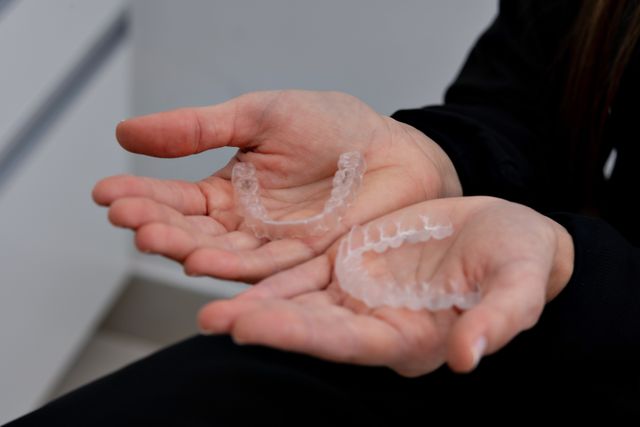
Some clinics offer their own 3D-printed aligners at lower prices than Invisalign. Here's an honest look at what's different, without the marketing.
Over the last few years, many clinics in India have started making aligners in-house: they scan your teeth, plan movement with general-purpose software, and print or thermoform trays on site. These can be cheaper and faster to deliver. Whether they're right for you depends mainly on how complex your case is.
| Invisalign | Typical in-house aligners | |
|---|---|---|
| Material | SmartTrack multi-layer material | Generic thermoplastic sheets (varies by clinic) |
| Planning software | ClinCheck, built on a large global case database | Third-party or open software; depends on the clinician |
| Attachments & features | Optimised attachments, precision wings, Teen compliance indicators | Basic attachments; features vary |
| Typical Hyderabad price | ₹1,20,000 – ₹3,50,000 | Often lower, from well under ₹1,00,000 |
| Turnaround | 3–4 weeks from scan | Can be days |
| Best suited for | Mild to complex, including many bite problems | Mostly mild, simple tooth movements |
Where In-House Aligners Can Make Sense
For very mild crowding or a small relapse after old braces, a well-run in-house system supervised by an orthodontist can be a reasonable budget option.
Where Invisalign Has the Edge
Questions to Ask Any Clinic
The doctor matters more than the brand. A skilled orthodontist with any good system will usually outperform an unsupervised plan with any brand.